It’s Not All Bad

Basic Income Would Solve A Lot

Growing arguments for a guaranteed basic income wouldn’t have stood a chance against the dominant market economics mindset I was trained on in the early 90’s. I’ve been surprised in recent years to see that the likes of Friedrich Hayek, Milton Friedman and even Charles Murray each put forth arguments for some form of income floor. There’s a strong case for public finance efficiency gains compared to our current bureaucratic welfare state – both for the government administrators and the individual recipients. Another argument I find especially compelling is that automation and scale are driving the marginal product of labor below the level needed to sustain basic human needs. The most timely argument relevant to our country’s current focus on racial justice is that an income guarantee could effect real and immediate progress for the past property right violations incurred by any and all affected groups. Moreover, such a solution focuses on a common future aspiration rather than debating and weighting any particular historical cause and stakeholder group. This and other arguments are summarized well in The Libertarian Case for a Basic Income:

A Basic Income Guarantee might be required on libertarian grounds as reparation for past injustice.

One of libertarianism’s most distinctive commitments is its belief in the near‐​inviolability of private property rights. But it does not follow from this commitment that the existing distribution of property rights ought to be regarded as inviolable, because the existing distribution is in many ways the product of past acts of uncompensated theft and violence.

Matt Zwolinsky, The Libertarian Case for a Basic Income, 12/5/2013, Libertarianism.org

As we discern our future in a time of intense debate about racial inequality and fast changing labor economics, it’s promising to see how the economic thinkers who argued for the benefits of free markets also provide foundational arguments for reconciling the gaps that remain.
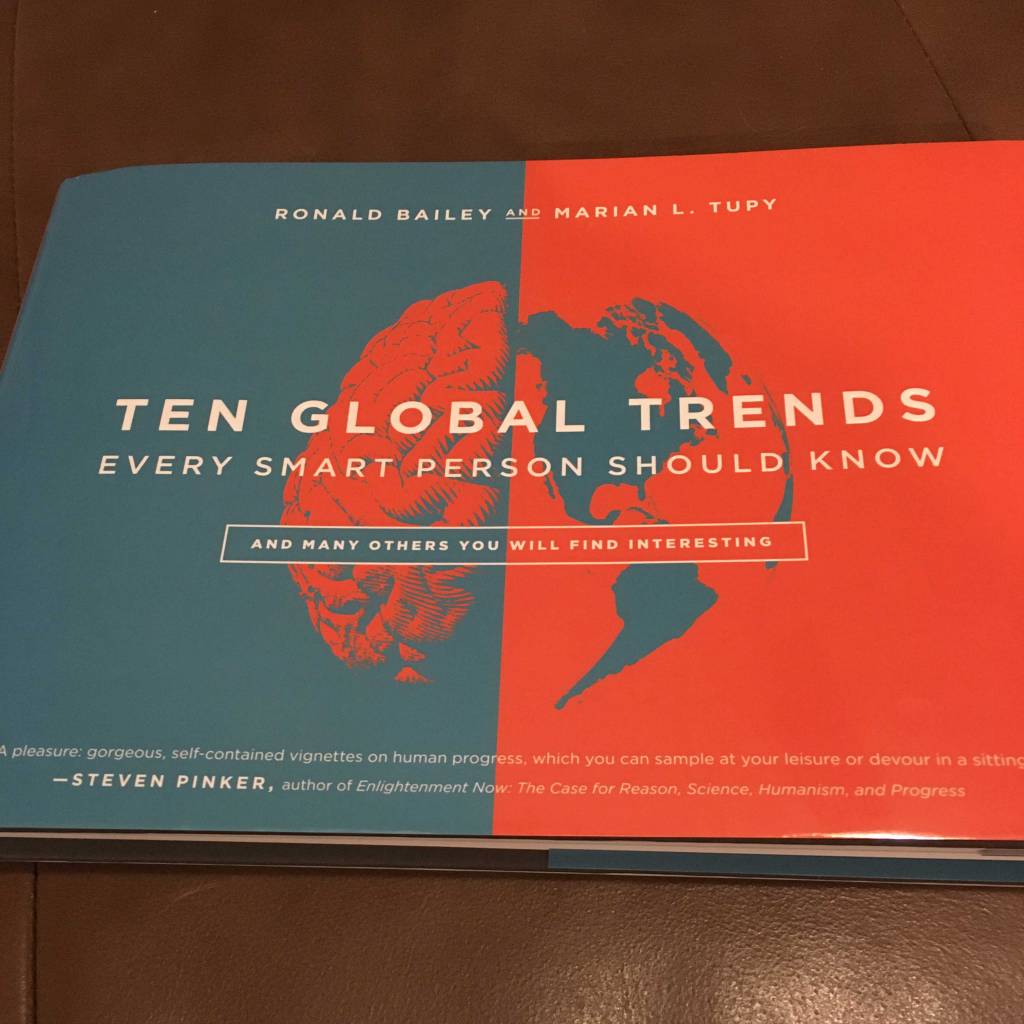
On Range: Why Generalists Triumph in a Specialized World

Every so often, a book sticks with you and keeps returning to mind for various reasons. Range has been one such book for me. The main theme is that you don’t have to specialize, and moreover, that generalists often find their various collections of experiences integrate into a robust talent synthesis especially powerful in our complex and fast changing economy. Having two sons who just headed back to campus, I’ve been thinking a lot about how college students are continually pushed to select and complete that single best choice of a major. It will be another ten or twenty years before they can fully appreciate how that selection was at most a best guess that prepared them to explore in the right direction. I’ve also been thinking about my own career. I spent my early years obsessing about finding that perfect career path. Though I stayed within the same industry, I tried roles ranging from sales to technology, ultimately gravitating to customer experience strategy and analytics. No single job was the perfect choice. But the combination of them has led to a fulfilling career and a marketable skill set that I never could have roadmapped for myself over two decades ago. One key point from the book is that successful people often got there by making a series of short-term adjustments based on what they could see immediately from where they were at each stage. Though counter to the common advice to “chart your course,” the sequential, short-term planning approach appears to work better. You maximize your skills and find fulfillment more frequently. That’s the advice I would give to all of the returning students today, and to myself twenty years ago.

Shall We Step Outside (The Echo Chamber)?

The big issues right in front of us right now have been making me want to take action. What action to take hasn’t been as clear, and so I’ve found myself reading and reflecting a lot this summer, in search of a direction. A common theme in the “how-to” of anti-racism has been a suggestion to start by listening and discussing, first steps that seemed far too passive to me at first but which have proven more clarifying and useful than I originally expected. At home and at work, I’ve benefited from deeper discussions about racism. I’m apparently not alone. In the past few days, I’m seeing more dialogue opening up. From what I can tell, social media is still an echo chamber of ranting and digging in on the same repeated points. In more thoughtful media and in actual person-to-person conversations, I’m seeing a change. People are starting to talk about how to have a constructive dialogue. In course, they’re realizing we have more common ground than many of us realized. A good example is this recent op-ed in USA Today: Americans appear to be deeply divided. But we found a different story traveling the U.S.  I’m also seeing articles about how to go about having a constructive dialogue, such as How to (Actually) Change Someone’s Mind in HBR. I’m only through the intro so far for A House Divided: Engaging the Issues through the Politics of Compassion, but it’s already reinforcing that we need to seek out shared aspirations, such as helping each other, and then to look for initial axioms we can agree on and build upon together. Perhaps finding the right actions to take really is as simple as deciding together, in actual person-to-person dialogue, what really matters.

Best Coronavirus Visualizations

Amid the frenzy of speculative and repetitive articles, it’s helpful to find a simple display of the latest data.

ejxOk-coronavirus-covid-19-cases-worldwide

There are other charts with daily updates here at Datawrapper.

Fireworks Chart Shows the Explosive Power of Data Visualization

This chart at Stat News tells the story of July 4th injuries so much better than was possible with the tools we had even a few years ago. The subject, fireworks, are used to represent each data point, plus the chart is interactive. Hovering over a data point gives specifics about one of the injuries underlying the data.  The full article is worth a look for the other visualizations, as are other visualizations by Natalia Bronshtein‏ @ininteraction.

Chef Demonstrates Test/Control Thinking

Using test/control methods is primarily about understanding the way of thinking rather than knowing any specific comparison framework or statistical test. It’s often an art figuring out which factors to isolate. Ideally, the test is based on some hypothesis about the underlying behavioral dynamics. Especially in B2B, we don’t always get a giant sample to hold out, so being specific and focused about what to test is critical.

This chef gets it. His hypothesis: ripening tomatoes lose moisture around the stem. A little tape and a few days proves his point, so store them upside down. How did I grow up in a town with a Tomato Festival Parade and still not know this?


Measurement as a source of innovation

2017-05-10 21.50.27Makers of men’s shirts have finally figured out a model for providing custom orders tailored to individual dimensions. Prompted by the ads prevalent across social media and professional blog spaces, I recently ordered custom shirts from two different providers. One maker promised a great fit based on a predictive algorithm; the other provided a how-to guide for measuring my own exact dimensions. The shirt based on measurement is now the best fitting shirt in my closet, while the shirt based on prediction actually fits worse than many department store brands.
Predictive analytics is as much as ever the exciting frontier in our field. Yet we too often undervalue the importance of better measurement as a source of innovation. My now favorite clothier figured out how to achieve sufficiently precise self-service tailoring in the convenience of home. In fitness and health, sensors can track actual behavior that only a few years ago required expensive laboratory studies. Across many voice and text applications, the occurrence of specific words and overall sentiment have migrated from the qualitative to the quantitative. Today, innovation in business intelligence is as much about making measurement more precise and user friendly as it is about finding the right reporting engine and defining KPIs. The power of predictive analytics will certainly continue to expand. I expect the predicted shirt will someday be my favorite fit, though how it fits and how it looks will still be the ultimate measure.


Why the data needs a story

Storytelling data

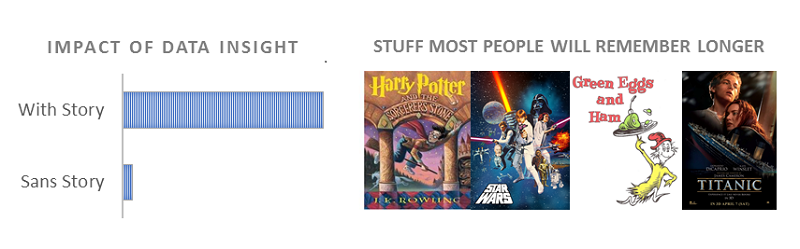
People in quantitative and scientific fields too often undervalue the importance of soft skills, including storytelling. Now the longstanding message from communications experts is increasingly backed by quantifiable findings. Speaker Carmine Gallo writes: “Thanks to advances in neuroscience, brain scans, and data-driven studies, we’ve learned more about persuasion in the past decade than we had ever known previously.” Neuroscientists can map our brain activity during stories. Data scientists have analyzed the content of TED talks and other speeches to conclude that “messages including apt, well-crafted stories are 35% more persuasive.” In The Leading Brain, the authors cite research showing “that people are more receptive to ideas when their minds are in story mode as opposed to when they are in a more analytical mind-set.”

For all of us quants, it would be ironic if it took the growing body of hard evidence to finally convince us of the importance of using stories to make our points.