My Favorite Articles This Week (12/27/20)

Archaeologists uncover ancient street food shop in Pompeii provides a realistic slice of Roman life, based on what pedestrians saw and consumed at a snack stand

Washington’s Secret to the Perfect Zoom Bookshelf? Buy It Wholesale. is about how political set designers and decorators order books by the foot for staging purposes. Maybe that talking head isn’t as well read as they appear. For the record, I don’t put a book upright on my shelf unless I’ve actually read it.

How to Be Bored gives perspectives about why we’re bored and the value of it. I can’t recall the last time I was truly bored. Maybe I should try it, but I’ve always lived by the mantra I read somewhere a long time ago: If you’re bored, it’s your own fault.

Best Ads of 2020 includes a curation of some truly creative and entertaining marketing

Why The Taste Of Bananas Will Change In A Few Years continues the recurring prophecy of the demise of bananas, though the article seems to equate zero taste as a change in taste. I’m ever hopeful that innovation and market forces will find a solution, perhaps improving the flavor in course.

They Went Out for a Bike Ride. They Never Came Home. Please share the road and drive with care for others.
My Favorite Articles This Week (12/20/20)

Mesmerizing, yes, and also tense

Why Is Napoleon Bonaparte Always Depicted With His Hand In His Coat? is historically interesting, and reminds me of the big portrait of our town’s namesake that hung in the student commons of Napoleon High School

A Weapons Master Explains How Armor Takes On Character Traits, And Rates Famous Medieval Scenes. I tend to enjoy this series where experts rate what they see in movies.

Why This Color Doesn’t Actually Exist will make you think differently about what we can and can’t see, even when we do

Favorite Articles from This Week

Our parents warned us the internet would break our brains. It broke theirs instead and What Facebook Fed the Baby Boomers – thoughtful perspective about how some of the most internet-vulnerable get caught in their own reality-warping echo chamber. “I do not think my older family members understand the extent to which the content they encounter is tailored by algorithms to set their lizard brains on fire.” (from first article)

How to Socialize in the Cold Without Being Miserable – useful as we plan for more socializing outdoors and consider the equipment needs of the homeless this winter. I still maintain Colorado has never been as cold as it was waiting for the school bus in the cold, fierce wind attacking from Lake Erie.

Former CIA Chief Of Disguise Reveals What Kinds Of Spy Gadgets Were Used During The Cold War, fascinating first-person review of Cold War-era spy gadgets

Wonder Why… Serve and Volley Went Out of Fashion in Tennis

Prisencolinensinainciusol, a song released in 1972 by singer Adriano Celentano, intended to sound to its Italian audience as if it is sung in English spoken with an American accent. It’s actually gibberish, but the song and the video both rock.

It’s Not All Bad

Best Coronavirus Visualizations

Amid the frenzy of speculative and repetitive articles, it’s helpful to find a simple display of the latest data.

ejxOk-coronavirus-covid-19-cases-worldwide

There are other charts with daily updates here at Datawrapper.

Fireworks Chart Shows the Explosive Power of Data Visualization

This chart at Stat News tells the story of July 4th injuries so much better than was possible with the tools we had even a few years ago. The subject, fireworks, are used to represent each data point, plus the chart is interactive. Hovering over a data point gives specifics about one of the injuries underlying the data.  The full article is worth a look for the other visualizations, as are other visualizations by Natalia Bronshtein‏ @ininteraction.

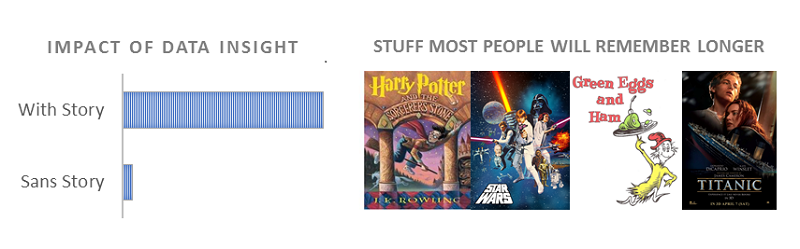
Why the data needs a story

Storytelling data

People in quantitative and scientific fields too often undervalue the importance of soft skills, including storytelling. Now the longstanding message from communications experts is increasingly backed by quantifiable findings. Speaker Carmine Gallo writes: “Thanks to advances in neuroscience, brain scans, and data-driven studies, we’ve learned more about persuasion in the past decade than we had ever known previously.” Neuroscientists can map our brain activity during stories. Data scientists have analyzed the content of TED talks and other speeches to conclude that “messages including apt, well-crafted stories are 35% more persuasive.” In The Leading Brain, the authors cite research showing “that people are more receptive to ideas when their minds are in story mode as opposed to when they are in a more analytical mind-set.”

For all of us quants, it would be ironic if it took the growing body of hard evidence to finally convince us of the importance of using stories to make our points.